MP Calls for UN Disability Rights Law to Protect Disabled People
Marsha De Cordova MP told the House of Commons Petitions Committee the UK must fully adopt the UN Convention on the Rights of Persons with Disabilities. Disabled people are facing rising poverty, social care debt and energy costs they cannot afford.
The case made to Parliament
Disabled people across the UK are facing rising living costs, deepening poverty, and growing social care debt. At a session of the House of Commons Petitions Committee, MP Marsha De Cordova made a direct call: the UK Government must fully adopt the United Nations Convention on the Rights of Persons with Disabilities (UNCRPD) to protect disabled people's civil and human rights.
The committee was responding to two public petitions backed by hundreds of personal testimonies from disabled people describing how rising costs and inadequate support are affecting their health, independence and dignity.
Social care charges pushing disabled people into debt
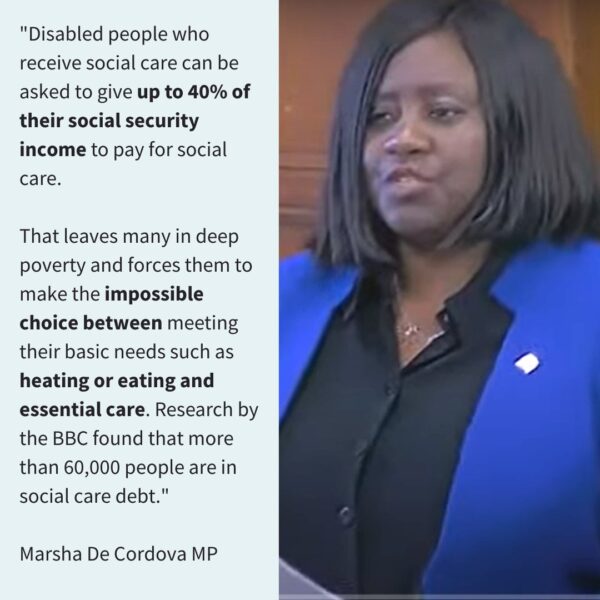
Marsha De Cordova MP highlights how social care charges push disabled people into poverty.
Marsha De Cordova MP explained that many disabled people are being charged up to 40% of their social security income to fund their own social care. This leaves people in deep poverty and forces impossible decisions between food, heating, medication, and essential support.
Disabled people who receive social care can be asked to give up to 40% of their social security income. That leaves many in deep poverty and forces them to make impossible choices. Marsha De Cordova MP, House of Commons Petitions Committee
Research cited in the session found that more than 60,000 disabled people are now in social care debt, a figure that reflects the structural failure to fund care adequately and the disproportionate burden placed on disabled people to pay for support they are legally entitled to.
At Difference North East, we see the impact of this in the North East every day. The region already has the highest proportion of disabled residents in England (21% of the population), and many of those people are navigating social care systems while managing the same cost pressures described to Parliament. You can read what disabled people in our region are experiencing in our Access to the Everyday Report 2026.
Why the UN Convention on Disability Rights matters
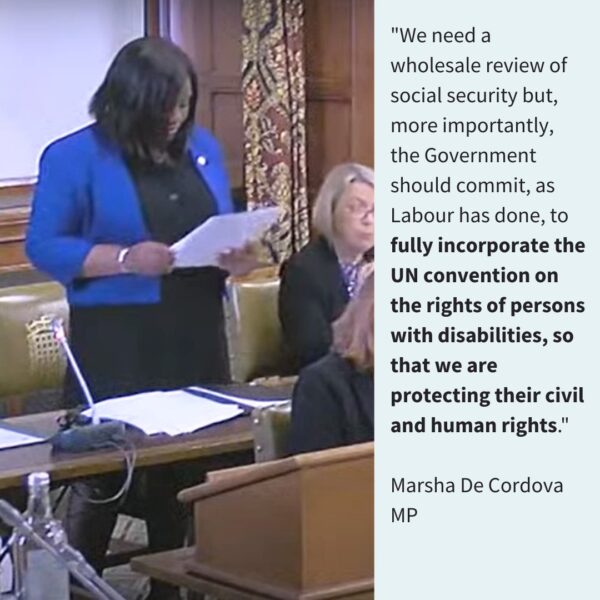
Marsha De Cordova MP calls for full legal incorporation of the UNCRPD into UK law.
Marsha De Cordova MP argued that piecemeal reforms are not enough. The UK Government must commit to full legal incorporation of the UNCRPD.
We need a wholesale review of social security, but more importantly, the government should fully incorporate the UN convention on the rights of persons with disabilities, so that we are protecting their civil and human rights. Marsha De Cordova MP, House of Commons Petitions Committee
The UNCRPD sets out disabled people's rights to independent living, dignity, social protection, access to services, and full participation in society. The UK ratified the convention in 2009 but has not incorporated it into domestic law, which means disabled people cannot directly enforce those rights in UK courts.
Disabled people's organisations, including Difference North East, have long argued that full incorporation would create stronger protections and accountability, shifting disability from a matter of charity or welfare policy to an enforceable matter of human rights law. This connects directly to the social model of disability that underpins our work: the barriers disabled people face are not inevitable, they are choices that can be changed through law and policy.
Cost of living crisis hits disabled people hardest
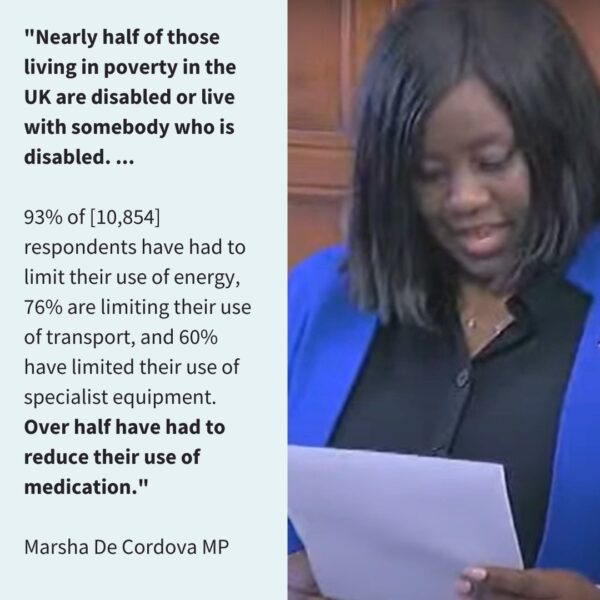
Disabled people are disproportionately affected by poverty and the rising cost of living.
During the committee session, Marsha De Cordova MP shared figures showing how the cost of living crisis is falling hardest on disabled people. Of disabled respondents surveyed, 93% had reduced their energy use, 76% were limiting transport, 60% had reduced use of specialist equipment, and over half had cut back on medication.
These are not trade-offs between luxuries. These are disabled people rationing medication, sitting in cold homes, and going without equipment their health depends on because the support systems meant to protect them have failed.
Disabled people in the North East face these pressures alongside specific regional challenges. Sparse public transport, older housing stock, and the highest rates of disabled residents in England mean the cost of disability in this region is particularly acute. Our Access to the Everyday Report 2026 documents these realities directly from the people experiencing them. We also continue to campaign on welfare reform: see our coverage of the PIP cuts and their impact on the North East.
The petitions presented to Parliament
The Petitions Committee session was responding to two public petitions, both driven by disabled people sharing their lived experience of inadequate government support:
- Make people on disability benefits eligible for the £650 one-off payment
- Provide an energy grant to people with a disability or serious medical condition
Both petitions included hundreds of personal testimonies. The committee's willingness to debate them reflects the scale of public concern. But as Marsha De Cordova MP argued, individual grants and one-off payments are not enough. Structural change, anchored in enforceable human rights law, is what disabled people need.
Watch: Parliament debates disability rights and cost of living
The video below shows the Petitions Committee session, including Marsha De Cordova MP's speech and the testimony of disabled people and campaigners.
What this means for the North East
The North East has the highest proportion of disabled residents of any English region. 21% of people here are disabled, and that means the gap between what disabled people are entitled to and what they actually receive is wider here than almost anywhere else in the country.
Difference North East supports Marsha De Cordova MP's call for full incorporation of the UNCRPD into UK law. We also support it because we have heard, directly from our members, what happens when rights exist on paper but cannot be enforced in practice: the social care debt, the rationed medication, the buses that don't show up, the workplaces that treat adjustments as favours.
If you have been affected by social care charges, benefit cuts, or the cost of living crisis, we want to hear from you. Your story matters and it feeds directly into the evidence base for campaigns like this one.
You can also read our position on disability, poverty and social justice and our analysis of welfare reforms and their impact on disabled people.
Fight for disability rights with us
Disabled people deserve dignity, financial security, and real protection of our human rights. Join Difference North East. Membership is free.
Become a member Share your story