Teesside Community Voices • Stockton-on-Tees, May 2025
Voices from Stockton-on-Tees
A wide-ranging conversation on disability, access and community from the streets of Stockton to the corridors of power that still don't listen
Published 14 May 2025 • 10 min read
The Room That Could Have Talked All Day
They were supposed to get through eight questions. Nearly two hours later, they had answered one and had barely scratched the surface of what needed saying.
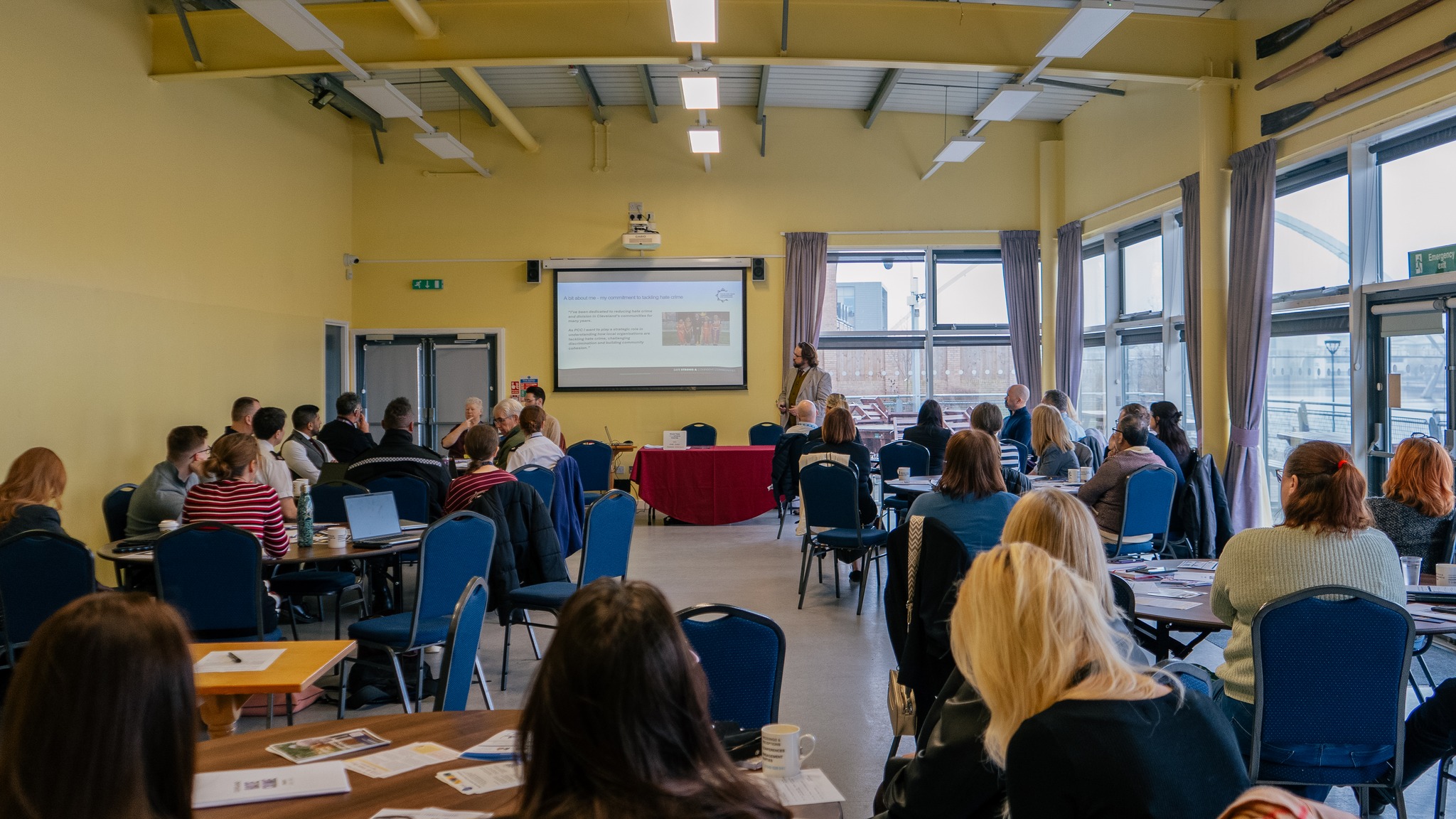
The Stockton-on-Tees session was the largest and most varied in the series: and included 80-year-old former councillor who spent 40 years at the CAB; a blind ex-Paralympian with seven guide dogs and a gold medal for discus; a young autistic woman with ulcerative colitis who had been told the Job Centre was sending her to become a truck driver; a brain bleed survivor rebuilding her life after a career she had spent years building was taken from her in an afternoon; a charity advocate who had been told she could not Work when a brain tumour was diagnosed; a man with a hidden brain haemorrhage; and a facilitator from Difference North East who lost her own job to disability and found her calling in fighting back.
Between them, they covered blue badge parking shortfalls across Stockton, missing mobility scooters at Teesside Park, taxi drivers who clock wheelchair users and cancel the booking, PIP tribunals in Middlesbrough, a Job Centre without an accessible toilet, and why a disabled person who misses a train connection can end up getting home two and a half hours after everyone else. Every story connected to the same thread: a society that keeps designing things without asking the people most affected by them.
Key Themes
Transport & Taxis
Only 12 wheelchair-accessible taxis in Stockton. Drivers who see a wheelchair and cancel. A "turn up and go" right in law that is impossible to use in practice.
Teesside Park & Retail
No mobility scooters or wheelchair hire. Blue badge bays blocked by new planting. A pharmacy closure that pushed more people toward an inaccessible site.
PIP & Benefits
Tribunals, tribunal panic attacks, back-payments fought all the way to the House of Lords and a DWP that deletes evidence after 14 months without telling anyone.
Employment & Identity
Jobs lost to disability, Job Centres sending people to truck driving, and the slow, powerful process of finding out that who you were forced to become is actually who you were meant to be.
Getting Around Stockton: A Tale of Two North Easts
One of the session's most revealing moments came when a Difference North east member, compared public transport in Teesside to what she experiences visiting colleagues in Newcastle. In Newcastle, almost every bus is electric with audio announcements, visual stop displays, and automatic lowering. The kerb heights are calibrated so that buses arrive level with pavements. There is a Metro.
"If you think that's terrible, that's like golden to me. Come to Teesside! I don't realise sometimes how poor transport infrastructure is here until I go somewhere else, and then I'm like, wow." Difference North east member, Stockton session
For a young autistic member, the newer electric buses in Teesside are transformative precisely because they have announcement systems. Without them, she has ended up on the wrong route, stranded, unable to remember how to get home. She now does formal travel training before visiting anywhere new. For another, who is blind and has been navigating public transport independently for decades, the bus stop buttons with Braille are progress but the talking announcements are often simply switched off, because sighted passengers complain.
Only 12 Wheelchair-Accessible Taxis in Stockton
Taxi access generated some of the most striking stories of the session. one member described using an app-based taxi service, watching the car approach on the map, seeing the driver clearly register her rollator and then watching the app switch to "finding you a new driver." He had cancelled the booking on sight.
A blind member described booking a taxi the night before to get to the train station, confirming all arrangements including her guide dog, calling at five to eight when no driver had arrived, being transferred to the driver who then disconnected the call, going through the whole explanation a second time, a third time, and eventually seeing the taxi arrive at 18 minutes past eight. She missed the train. She filed a formal complaint on the taxi company's website. The auto-reply said no one was monitoring it.
"I shouldn't have to book 24 hours in advance. I shouldn't have to do it with only 12 wheelchair-accessible taxis in the whole of Stockton. I should be able to, just like everybody else, want a taxi and get a taxi." Difference North east member, Stockton session
A member who was a former taxi driver explained the structural reason: drivers are overwhelmingly self-employed, wheelchair jobs pay the same rate as any other, and the additional time and effort involved means drivers systematically avoid them. A Hackney carriage on a night out will drive past a wheelchair user without stopping. This is not individual prejudice alone it is an economic structure that treats access as someone else's problem.
The Hidden Time Cost of Disability
A difference north east member described what she calls "the hidden time cost of disability" the compounding delay that follows any disruption in the transport chain. Two people get off a train. The connecting train is cancelled. A replacement bus is laid on. The non-disabled person gets on the bus and is home in half an hour. The wheelchair user finds the replacement bus is inaccessible. They call for a wheelchair taxi. In Hartlepool, wheelchair taxis require 24 hours' notice. They wait. It starts to rain. A taxi is finally sourced from Stockton. The driver doesn't know the area. The nearest dropped kerb is streets away. The disabled person gets home two and a half hours after the non-disabled person. Same journey, same cancellation, completely different outcome.
Trains: A Right That Exists Only on Paper
Disabled passengers in the UK have a legal right to "turn up and go" on trains to board without pre-booking assistance. In practice, this right is largely unenforceable. A difference north east member described arriving at a train platform without a pre-booked ramp and finding no one available to lift it off the wall. Another described an experience where a platform connection at Darlington meant crossing a large bridge in five minutes with a restricted walking ability just making it onto the train. As another member noted: 40% of railway stations in the UK still have step-only access. The Disability Discrimination Act has been in force since 1995. The basics are still being argued about.
Teesside Park: An Accessible Destination That Isn't
Teesside Park came up more than once, and each time the picture it painted was the same: a major retail destination in the heart of the Tees Valley that has become progressively harder for disabled people to use, at the exact moment more disabled people need it.
One member, a former Stockton councillor, had needed to visit Marks & Spencer for a bra fitting while barely able to walk, ahead of a knee operation. She rang ahead. M&S said they didn't have wheelchairs, but Teesside Park did. Her husband went to the Hello information centre on arrival. They said they didn't have wheelchairs. Eventually it emerged that one wheelchair existed reserved exclusively for people taken ill or injured on site. The website, meanwhile, still stated that wheelchair hire was available. No one had updated it.
A member's mother, who has serious spinal injuries following neck surgery, can only manage short distances. To visit two shops at Teesside Park, she has to physically move the car between each one. The distances between stores are simply too great.
"Why can't they just hire out a wheelchair at Teesside Park?" Difference North East member, Stockton session
One member had already been working on this. She had contacted Shop Mobility, who confirmed they are willing to supply mobility scooters and wheelchairs at cost and agree a maintenance schedule. She had raised it with Teesside Park directly. She had contacted the Tees Valley Combined Authority. Everyone agreed it was a good idea. Everyone stopped responding.
She submitted a question for the Tees Valley Mayor's first-ever public radio phone-in, asking him to prioritise a Shop Mobility unit at Teesside Park, operating from the Hello shop with reserved accessible parking bays at the front. The proposal is not complex, and the solution is already standing by. What is missing is the decision to fund it.
Blue Badges, Tactile Paving & the Consultation That Never Happens
The session produced a pointed moment of civic accountability. Difference North East member and former Stockton borough councillor with 30 years of service, said plainly: she had never heard of the 6% Blue Badge parking rule. Not once, in three decades of elected office covering disability issues.
A Difference North East member, who runs a disability organisation covering the full breadth of neurological conditions and neurodiversity, not just the narrow range the statutory sector tends to include has been raising this specific point with Stockton Borough Council for five years. Stockton is one of the worst performers in the North East. There is currently no disability officer at Stockton Council.
"Disability accessibility isn't on their agenda. The knowledge is very poor they should know, and they don't." Difference North East member, Stockton session
A Difference North East member raised the related problem with blue badge hospital parking. She travels to North Tees hospital with multiple different carers, depending on who is available. Hospital parking systems register the badge to a specific car number plate, meaning each different carer's vehicle is technically unregistered and liable to a fine. After she challenged this directly, the hospital agreed to log two vehicle registrations for her badge. It was a local fix for one person. The underlying policy registering a car rather than the person the badge belongs to remains unchanged everywhere else.
Tactile Paving: Where Access Needs Collide
One of the session's most instructive exchanges was a direct conversation between one Difference North East member, who has severe arthritis and finds the raised tactile paving at dropped kerbs acutely painful, and another, who is blind and relies on exactly the same paving to know she is at a crossing and safe to step off the pavement.
Both are right. The paving serves one need and creates another. They reached a practical conclusion together: the tactile surface does not need to span the full width of the dropped kerb, and the bumps could be smaller and more closely set without losing their navigational function. This is the kind of insight that only emerges when disabled people are genuinely involved in design not consulted afterwards, but present from the beginning.
Another member raised the planned Yarm town centre regeneration as a live example: significant public money is being spent on accessibility improvements, but there is no disability officer at the council, and she had seen no evidence of disabled people being meaningfully consulted on the plans. She noted that the fountain at the end of Dovecot Street in Stockton exists because she, at a planning stage consultation, pointed out that a flat-granite surface change was entirely invisible to blind people and she would walk straight into it. The steps that now mark the fountain's edge are there because someone asked.
"Back when there was the Cleveland Disability Association, people would go along with their aids and their white sticks and they assessed if it would work. Councils went berserk. But then they had to say: 'we consulted with this disability group and they said it was okay'." Difference North East member, Stockton session
PIP & Benefits: The Fight That Never Ends
Several participants in the Stockton session had fought for PIP all the way to tribunal. Every single one had been refused initially. Not one felt the process had been designed with them in mind.
One member's case went further than most: refused at the initial stage, refused at review, refused at tribunal, appealed all the way to the House of Lords, which sent it back for retrial at which point the tribunal finally awarded the benefit, back-dated to the beginning. She had been prepared to fight to the end. "People give in too easily," she said. "If you believe it go to the end."
Another described her own tribunal in Middlesbrough: arriving to find proceedings starting ten minutes late, triggering a panic attack; entering the room to face judge and assessors, triggering a second; being told by the judge that if she couldn't compose herself they would reschedule without anyone in the room apparently registering that this would simply repeat the same outcome every time. Her mother was not permitted to speak for her without being pushed back on. The Universal Credit officer cited two years of income that turned out not to exist. The process was revealed as one where evidence goes unchecked, assumptions go unchallenged, and the burden falls entirely on the person who is already unwell.
"If you didn't check that before you came here, how do we know anything else you're going to say is true?" Difference North East member, Stockton session, to the Universal Credit officer at her tribunal
The 14-Month Evidence Deletion Rule
A member raised a DWP practice that is not widely known: under GDPR rules, the DWP deletes supporting evidence after 14 months. If a PIP review is still outstanding at that point, the evidence submitted when the original claim was made is gone. The DWP can then open a review and state it has no evidence to support the claim. A member said they had already raised this with her MP, who wrote a ministerial question; the minister's response was that as long as the review is formally active, evidence submitted for that review remains live. But the rule itself and the risk it poses for people waiting in the backlog remains in place.
A Job Centre with No Accessible Toilet
When one member was first made redundant due to disability and had no income her husband's earnings placed her above the Universal Credit threshold, so no support was available she was called to the Job Centre. She asked where the accessible toilet was. There wasn't one. She used this as grounds to avoid attending all future appointments, because the venue itself was non-compliant. It is difficult to imagine a clearer illustration of the gap between what disability law requires and what actually exists.
Work, Identity & What Disability Takes and Gives Back
The Stockton session had some of the series' most honest reflections on what disability does to a person's sense of self and what can grow back in its place.
One member had worked for a disability charity after graduating, only to find that the organisation used her autism as a visible credential while systematically failing to support her. When her symptoms became visible, management became hostile. She left twice due to work-related mental health crises, was unemployed for two years, and was living with serious anxiety about returning to Work while the Job Centre sent her job matches for truck driving.
"The Job Centre, specifically 'you have to get Work, you can't stay on benefits forever.' I get that. But it's the physically going through interviews that gives me the anxiety, that sends me into the meltdowns, that sets me back into self-harm. Their argument is they're not there to find you 'the job' just 'a job'." Difference North east member, Stockton session
A member, who runs a Disability charity, described being told she needed to send back a grant she had just secured by a line manager who had decided, from the initial diagnosis of a brain tumour, that she was no longer capable of Work. The manager left. The member stayed, rebuilt the charity, and is now its lead advocate.
Another member, who had a brain bleed fifteen years ago that ended a publishing and academic career she had spent decades building, spoke about grief not just as loss but as dissonance: "My brain hasn't forgotten. The memory hasn't gone. So you've still got that. You want to think, 'well, that is my past.' You've got to think to the future, but it's still there."
And another member who had been told she would never Work again described two years of fighting for herself as the moment she discovered what she was actually for. The brain does not change. The person does not disappear. What disability does, sometimes, is strip away the Work you were doing and leave behind the work you were meant to do.
"Sometimes I think what you are, and who you are, and who you want to be, evolves because it has no choice." Difference North east member, Stockton session
Healthcare: The Reasonable Adjustment That Should Be Standard
The group discussed both failures and genuine examples of good practice in healthcare and the distance between the two was wide.
A member described her first colonoscopy: a diagnostic procedure the doctor said was necessary to prescribe medication. Her mother asked to accompany her into the room because she would not consent without her there. The doctor said the room was too small. Her mother said it was a choice: make the reasonable adjustment, or lose the diagnosis. The member had a panic attack on the table anyway. The doctor, unprepared for this, was more focused on telling her to stop moving than helping her through it.
Another member, meanwhile, described an MRI at North Tees in February. She was apprehensive. The team could not have done more: they talked her through everything, gave her a squeeze button, checked on her throughout an hour-long scan, and kept her friend in the waiting room informed throughout. "They were absolutely brilliant." another member noted that the MRI service at North Tees is run independently of the main NHS trust which may explain why.
It was highlighted that North Tees and South Tees Hospitals are among the better examples in the region: they invite people with lived experience onto the boards that oversee patient safety, report transparently on interpreter statistics and reasonable adjustment compliance, and acknowledge shortfalls openly. "They are trying their hardest to listen. And I think that's what's most important."
The Reasonable Adjustment Flag the forthcoming NHS-wide system that will for the first time require every part of health and social care to record and share a disabled person's communication and access needs was welcomed by everyone in the room. For one Difference North East member , who has been having to re-explain her needs to every new department for decades, the prospect of a flag that travels with her medical record rather than living only in her GP's system was significant. The mandatory compliance date is 31 December 2025.
The clearest summary of what the Stockton session was asking for came near its close: "What I've heard a lot of today around the room is just listen to us. We know what we need. We know what we want. Even if you don't have the money just even an acceptance that this needs to happen would go a long way." The distinction the facilitator drew was precise: not consultation conducted about disabled people, not services designed for them but decisions made with them.
Rebuilding a Teesside Disabled People's Forum
The old Cleveland Disability Forum no longer exists. In its place there is a gap one that every session in this series has surfaced in different ways. In Stockton, the group heard directly about efforts to fill it.
Five disabled people have been working for over a year to re-establish a Teesside-wide Disabled People's Forum: in Stockton, colleagues in Darlington, Hartlepool and Middlesbrough, holding firm on one condition. They will not do it for free, and they will not do it to serve someone else's organisational agenda.
"A lot of people use disabled people as a tick box very tokenistic. We don't want to bolster an organisation's agenda. We're doing this because we want to. We won't do it for somebody else." Difference North east member, Stockton session
A Difference north east member, who had been used as exactly that kind of credential at her previous employer "look, we have an autistic member" only to be told she could no longer use their services because it would be a conflict of interest, knew exactly what was being described. The risk is not hypothetical. It is a pattern disabled people and disability organisations across Teesside recognise immediately.
The MVDA is currently helping the group pursue funding. The forum would be peer-led, independent, and answerable to its members first. It would fill a structural hole that has left disability issues off Stockton Council's agenda for years a council that, as the session confirmed, currently has no disability officer.
What Stockton Needs: Practical, Possible, Overdue
When asked what one small, quick fix would most change their lives, participants in Stockton were characteristically precise. None of their answers required large budgets. All of them require someone to make a decision.
- A Shop Mobility unit at Teesside Park Shop Mobility are already willing to supply equipment at cost. The Hello shop has the space. The accessible parking bays are there. All that is missing is a decision from Teesside Park or the Tees Valley Combined Authority to fund a pilot.
- Accessible announcements on all Teesside buses as standard not a gradual fleet transition over years, but a commitment that visual and audio stop information is a baseline requirement, not a premium feature.
- Automatic ramps on all new train carriages so that "turn up and go" becomes a right that can actually be exercised, not one that exists in law while disabled people miss trains waiting for someone to lift a ramp off a wall.
- Blue badge parking compliance across Stockton every council should meet the 6% rule. Stockton is not meeting it. A council committee is currently reviewing blue badge provision in Stockton; it should have this information in front of it.
- Disability-trained taxi drivers with a visible sticker scheme standardised training, consistent application, visible in every taxi window across Teesside, not only on the small number of wheelchair-accessible vehicles.
- A disability officer reinstated at Stockton Council because the Yarm regeneration is happening now, and if disabled people are not in the room before the plans are set, the fountain at the end of Dovecot Street is how you end up with something people will walk into.
- Clear pavements, dropped kerbs maintained, and cars off pavements the unglamorous basics, raised at every single session in this series, still not consistently delivered.
The Closing Story
Claire, the facilitator, ended the session with a story from the day before. A deaf woman flew from Teesside Airport with seven deaf friends. At check-in, the system had flagged all eight as disabled. By the time the group reached the gate, seven wheelchairs were waiting for them.
They had walked in.
One of them briefly considered whether to put a hearing aid in the wheelchair and wheel it through the airport. They didn't. But the moment crystallised everything the session had been working towards for nearly two hours: access is not a chair. Access is not a ramp. Access is audio announcements on buses, and braille on lift buttons, and a taxi driver who doesn't drive away, and a planning meeting where someone who is blind is in the room before the fountain is designed. Access is everything. And in Stockton-on-Tees, in Teesside, in the North East most of it is still waiting to be built.
"Access is more than a chair. Access is more than a ramp. Access is everything we've spoken about today." Difference North east member, closing the Stockton session
Get Involved in Stockton & Teesside
These voices are part of a series of community conversations happening across Teesside, Hartlepool, Darlington, Stockton and the wider North East. The report from all sessions will be released in November 2025, 30 years after the Disability Discrimination Act. Local decision-makers will be invited to hear it directly. Your voice can be part of it.
Connect with Local disabled people in Stockton-on-Tees and Teesside Share Your Story about your experience in Stockton-on-Tees and TeessideQuotes and content drawn from the Voices from Stockton-on-Tees community discussion, 14 May 2025, Stockton-on-Tees.
All voices have been shared in line with session ground rules. This article is part of a series on disability and community across Teesside, Hartlepool, Stockton, Darlington, Gateshead and the wider North East.
Related Posts

Access to Work Parliamentary Inquiry