
Win! The 9:30am Bus Pass Restriction Is Being Scrapped
Two years of letters, a parliamentary vote, hundreds of shared stories, and a direct letter to the Prime Minister, the Government has finally moved.
Disabled Bus pass Win: The news
On 18 August 2026, the Government confirmed that all time restrictions on the Disabled Person’s Bus Pass in England will end from 1 April 2027.
A £60 million funding package, £40 million from the Department for Work and Pensions and £20 million from the Department for Transport, will back the change, which Work and Pensions Minister Lilian Greenwood described as an “indefinite commitment”.
For the first time, disabled bus pass holders across England will be able to travel free at any time of day, not just after 9:30am on weekdays.
This is the change Difference North East has been fighting for since 2025, as part of our Getting from A to B campaign. We’re marking it as a win! & we want every member, ally, and supporter who shared a story, signed a form, or simply kept telling us why this mattered to know: it made a difference.
Disabled Bus pass Win: Why this restriction mattered
Maybe the rule sounds small, that is, until you’re the one living with it.
The English National Concessionary Travel Scheme has, until now, only given free bus travel from 9:30am to 11pm on weekdays. For disabled people with early hospital appointments, non‑standard working patterns, or caring responsibilities that don’t fit a 9:30am start, that gap has meant: Paying full fare you can’t afford, rearranging your life around a bus timetable, or simply not going.
As we said in our blog Too Late to Be Fair:
“Imagine having a hospital appointment at 9:15am and being told your pass doesn’t count until 9:30. Pay the fare, or miss the appointment.”
That was the choice too many disabled people in the North East were facing every single day.
But the restriction didn’t affect everyone equally. Race, gender, class, where you live, and whether you have access to a car all shape who could travel and who was left behind.
Disabled women are more likely to have caring responsibilities that require early morning travel. School runs, caring for older relatives, supporting other family members. Women make 36% more education/escort education trips than men.
This restriction didn’t just impact individuals it reinforced and compounded existing inequalities.
Disabled Bus pass Win: What this means for you from April 2027?
From 1 April 2027, if you have a Disabled Person’s Bus Pass in England, you can use it:
At any time of day, no more waiting until 9:30am. On any day of the week, the restriction applied to weekdays only, so weekends were already free, but now every day is unrestricted. For any journey, work, hospital, shopping, seeing friends!
For carers:
If you travel with the person you support, and they have a pass, this means you can get to early appointments without paying full fare, or without having to wait around for the clock to tick past 9:30.
How we got here
This win didn’t happen accidentally. It’s the result of a campaign that ran through Westminster, through our regional Mayors, and through the everyday experiences of our members.
📅 Difference North East writes to the Department for Transport.
We set out, in plain terms, the impact the 9:30am restriction was having on disabled people across the region.
📅 Simon Lightwood MP responds.

📅 10 September 2025: Parliament debates New Clause 2.
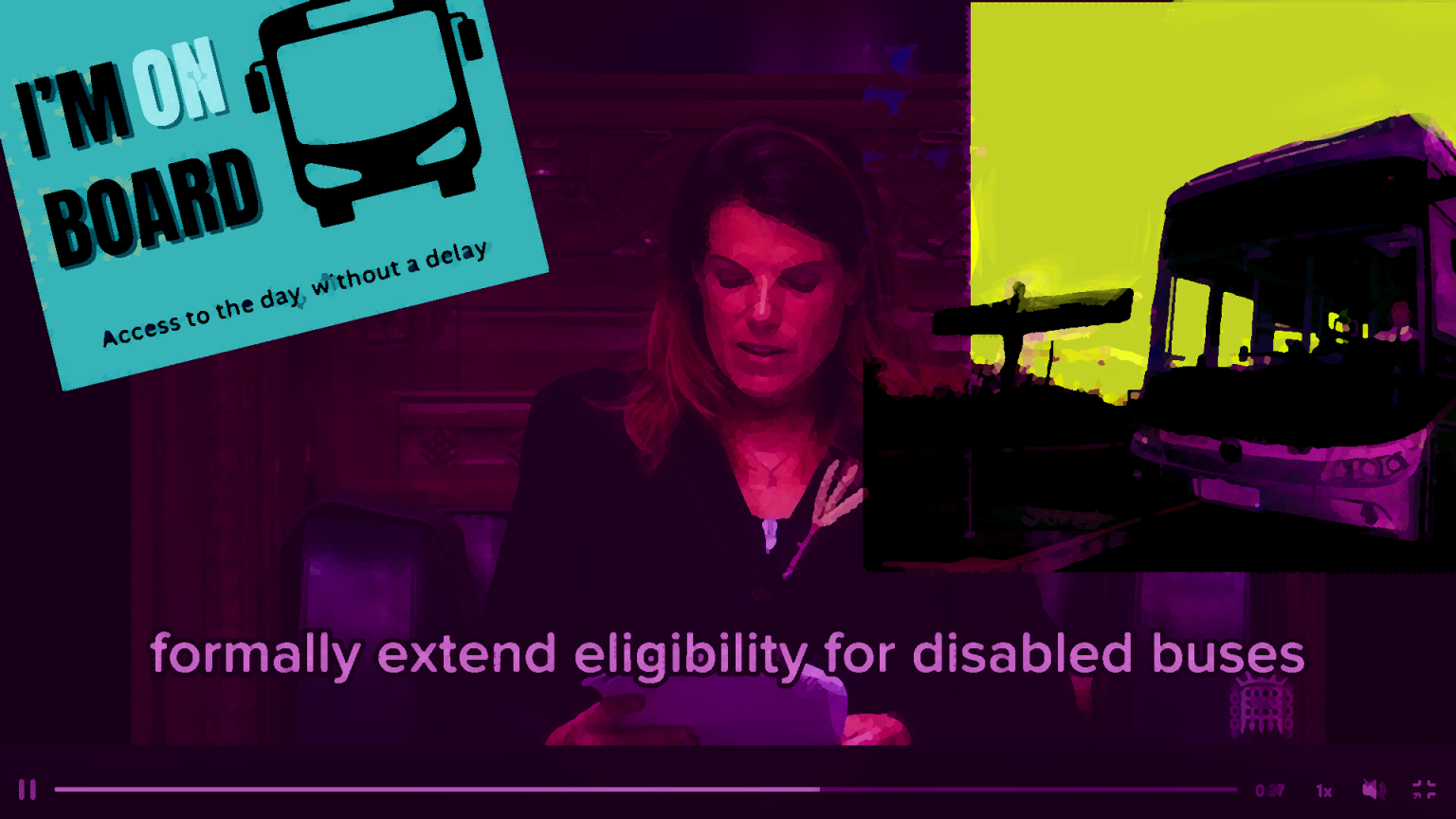
During the Bus Services Bill, an amendment tabled by Tom Gordon MP to remove the 9:30am restriction nationally was debated in the Commons. It was defeated, 69 votes to 300, but as we wrote at the time in Too Late to Be Fair, the national result was a setback, not an ending. We refocused the campaign locally.
We signed Transport for Alls open letter to ‘Unlock Transport Access’ in October 2025
📅 January 2026: Building Momentum for Fair Travel.

1. Mary Kelly Foy MP for City of Durham confirmed her office’s full support for every action we had asked for, and committed to following up. In her words: it was “a simple, fair change that would make everyday life easier” for disabled people in Durham and across the region.
2. North East Mayor Kim McGuinness gave a constructive response. Her office acknowledged the unfair postcode lottery disabled people face across the region, and confirmed our proposal to lift the restriction would be considered as part of wider discussions on transport reform and funding. Particularly as the North East moves towards bringing buses back into public control.
3. The Minister for Disabled People also responded to our concerns around this time, pointing out that local authorities and Mayors have the power to act so disabled people aren’t left isolated.
📅 Our members’ stories carried the weight.
At the heart of the campaign was Delta, a Difference North East member from County Durham. She told us that unreliable bus times combined with taxi fares she often couldn’t afford left her, in her words, “feeling trapped”, cut off from work, appointments and friends, when all she wanted was the same independence everyone else has.
It’s stories like Delta’s, not just statistics, that turned this from a polite letter into a national announcement.
📅 21 July 2026: an open letter to the Prime Minister.

By this point, Andy Burnham, the man who had already scrapped the same restriction in Greater Manchester as Mayor, was Prime Minister. Difference North East’s Director, Dr Christopher Hartworth, wrote to him directly at 10 Downing Street.
We asked him, as Prime Minister, to use his unique position to encourage regional Mayors to follow the example he’d already set, and to champion the change nationally.
Our members drove this letter. It wasn’t written in an office by staff alone, it came from the stories we’d collected, like Delta’s, and from the collective voice of the disabled people we represent.
📅 18 August 2026: the Government moves – under the Prime Minister we wrote to.
Less than a month after our letter, the Government confirmed all time restrictions on the Disabled Person’s Bus Pass will be lifted from April 2027, backed by £60 million in cross‑government funding.
We can’t claim a single letter changed government policy on its own this was the product of years of campaigning, by us and by others, converging at once. But it’s difficult to look at the timeline and not feel that writing directly to a Prime Minister who already understood the issue, at exactly the right moment, played its part.
What this win builds on
This announcement doesn’t come out of nowhere.
Andy Burnham removed all time restrictions on Greater Manchester’s Bee Network as Mayor, made permanent from March 2026.
It also reflects years of campaigning by organisations including Transport for All, Bus Users UK and Whizz Kidz, alongside our own regional push and that of disabled people’s organisations across the country.
The issue had become political ping‑pong at Westminster too: during the Bus Services Bill, Labour MP Tom Gordon tabled the amendment to remove all time restrictions nationally, while Conservative MP Jeremy Lewis pushed separately for Companion Passes to be written into statutory legislation. Neither succeeded in getting their amendment through at the time, but both kept the pressure on.
As Sophia Kleanthous, Policy and Campaigns Officer at Disability Rights UK, put it:
But she was clear this is only part of the journey, with eligibility still tied to a benefit system that isn’t meeting everyone’s needs.
We agree & we’d add that this win belongs just as much to every disabled person in the North East who told us their bus pass wasn’t working for them.
The fight isn’t over
We’re celebrating this properly because it’s a change that people will actually feel, it makes everyday life easier for thousands of disabled people.
But we’re not stopping here.
| Issue | What’s still to fight for |
|---|---|
| Buses only | Disabled people who rely on trains, trams or other transport still face the same restrictions |
| Companion Passes | Still not in statutory legislation, many disabled people can only travel with support |
| Postcode lottery | Eligibility is still set locally and still tied heavily to PIP, a benefit system that isn’t working |
| Enforcement and access | A pass is only useful if ramps are deployed, drivers wait, and information is available |
| Intersecting barriers | Race, gender, class, and where you live all shape who can travel we’ll keep pushing for everyone! |
What professionals and allies can do
If you work in health, social care, education, housing, transport planning, or any other sector that supports disabled people you have a role to play.
You can:
Share this campaign with disabled people you support! Use your professional networks to amplify the message! Challenge your organisation to remove its own time-based barriers! Become an ally – support the campaign without speaking over disabled people.
If you’re not yet a member, what are you waiting for?
When you join Difference North East, you get:
Practical, non‑jargon information, exactly what helped win this campaign
A community of disabled people – no need to explain yourself
A real say in what we campaign on next. This win happened because members told us what mattered!
A warm welcome – whether you’ve been disabled for decades or are still figuring it out
Join us today – it’s free, and it makes a difference.
Not ready to join? That’s okay too.
You can:
📱 Follow us on social media – no commitment, just content &💬 Share this blog – even if you’re not ready to act yourself, you can help someone who is
💡 “I don’t think I’m disabled enough to join.” We frequently hear this.
If you’re wondering whether you belong – you do. We don’t have a threshold test. We don’t ask you to prove anything. If the campaigns we run affect you, if the changes we fight for make your life easier – you’re welcome here.